
Minibus Transport vs Full Truckload
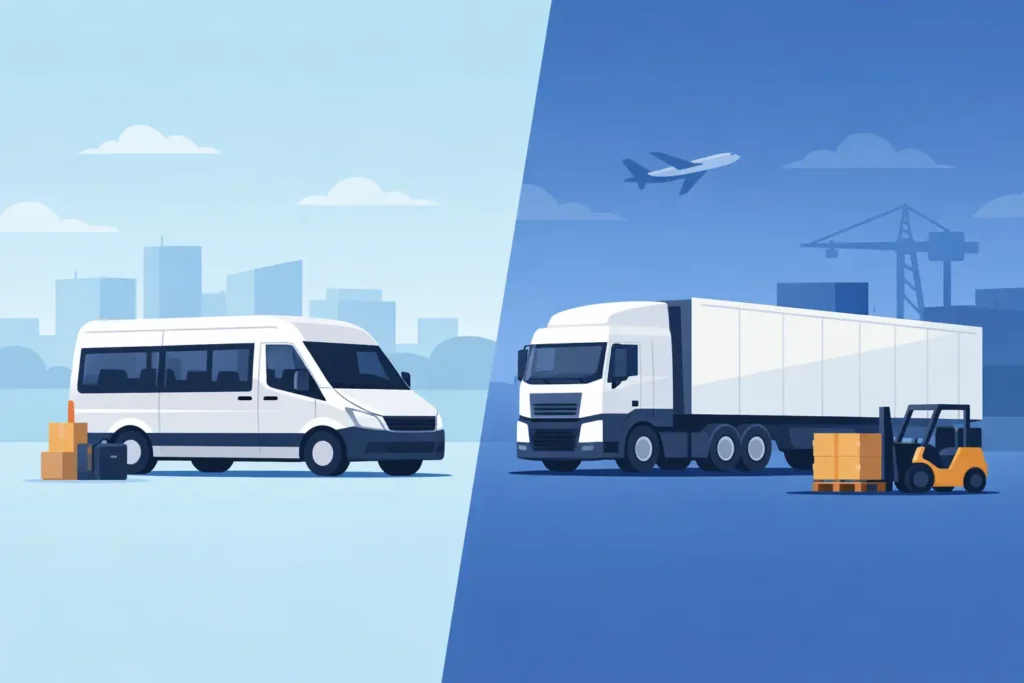
A shipment misses its delivery window by six hours, not because the route was wrong, but because the vehicle type was. That is usually where the real decision starts in minibus transport vs full truckload – not with labels, but with what the load needs, how fast it must move, and how much control you need from pickup to delivery.
For operations teams, this choice affects more than freight cost. It changes handling risk, scheduling flexibility, documentation flow, site access, and the amount of coordination required across borders. If you are moving time-sensitive goods, small palletized freight, equipment, event materials, or mixed loads that do not justify a dedicated trailer, the difference becomes operational very quickly.
What minibus transport vs full truckload really means
Minibus transport usually refers to smaller dedicated vehicles used for urgent, compact, or lower-volume shipments. In practical terms, that often means vans or minibus-sized transport capacity suited to cargo that needs direct movement without paying for unused trailer space. These vehicles are especially useful when access is tight, delivery points are urban, or the load is relatively small but still too important for standard parcel handling.
Full truckload, or FTL, means booking the entire truck for one shipment. The cargo does not share trailer space with other shippers, and the route is planned around that load. FTL is typically the right fit when freight volume is large enough to fill most or all of the trailer, or when the shipment requires a higher level of isolation, security, or process control.
The comparison is not small vehicle versus big vehicle in a simplistic sense. It is about matching capacity, transit expectations, and operating conditions to the shipment profile.
When minibus transport makes more sense
Minibus transport is strongest when speed and flexibility matter more than maximum volume. If your load is too large for standard courier services but too small to justify a full trailer, a smaller dedicated vehicle often gives you the cleanest solution.
This is common in sectors where downtime is expensive. A manufacturer may need urgent replacement parts sent across a border overnight. A trade show team may need printed materials, display hardware, and electronics delivered to a venue with restricted access. A retail operator may need high-value items moved directly to a city-center location where a large truck creates unloading problems.
In these situations, the value is not just lower capacity. It is reduced friction. Smaller vehicles can load faster, route more directly, and reach places that are inconvenient for standard heavy freight equipment. They also make sense when handling needs to stay minimal. The fewer transfers a shipment goes through, the easier it is to maintain accountability.
Cost can also work in minibus transport’s favor, but only in the right lane. For low-volume, high-priority freight, paying for a full truck often means paying for empty space. A smaller dedicated vehicle can reduce wasted spend while still preserving direct delivery and real-time visibility.
Best-fit use cases for minibus transport
The strongest use cases are urgent spare parts, medical or technical equipment, event logistics, small pallet runs, document-sensitive shipments, and direct city deliveries. It also fits companies that need a dedicated movement option without waiting to consolidate freight.
That said, there is a ceiling. Once the shipment volume grows, loading dimensions become awkward, or pallet count increases beyond what a smaller vehicle can handle efficiently, the economics and practicality change fast.
When full truckload is the better option
FTL is built for scale, consistency, and dedicated line-haul control. If you are moving enough freight to occupy most of a trailer, the decision is usually straightforward. You want the capacity, the loading structure, and the protection that comes with having the vehicle allocated to your shipment.
This matters for manufacturers, distributors, and procurement teams moving bulk goods, large pallet counts, machinery, or freight with special loading requirements. FTL can simplify planning because the equipment is standardized, capacity is predictable, and loading docks are usually designed around these vehicles.
It also becomes the stronger choice when the freight needs stability over long distances. Trailer-based transport is often better suited for heavy or bulky cargo, especially when weight distribution, securing methods, and unloading processes need formal control. If your shipment involves multiple pallets, stack restrictions, or goods that require specific trailer conditions, FTL gives you more room to manage those requirements properly.
From a unit-cost perspective, FTL usually improves as volume increases. Once you are moving enough freight, the cost per pallet or per unit often becomes more favorable than trying to split loads across smaller dedicated vehicles.
Best-fit use cases for full truckload
FTL is a strong fit for replenishment shipments, plant-to-warehouse transfers, large wholesale orders, bulky commercial equipment, and recurring cross-border lanes with stable volume. It is also the safer operational choice when loading needs forklifts, docks, or trailer-specific restraint methods.
Cost is not just the rate
One of the most common mistakes in minibus transport vs full truckload decisions is comparing only the quoted rate. The more useful question is total movement cost.
A minibus shipment may show a lower line-haul cost for small freight, but that is only part of the picture. If the load barely fits, requires multiple trips, or causes loading inefficiency, the saving disappears. On the other hand, an FTL quote may look expensive until you factor in the cost of delays, rehandling, missed appointments, or using the wrong vehicle for a site with difficult access.
Procurement teams usually get better results when they price the move against five things: shipment volume, urgency, handling risk, route complexity, and delivery conditions. A lower upfront rate is not a better deal if it creates more exceptions to manage.
Speed, access, and scheduling flexibility
Smaller dedicated vehicles often win on responsiveness. They are easier to dispatch, quicker to load for urgent moves, and better suited to locations where urban restrictions or narrow delivery windows create friction. If your operation depends on rapid reaction, that flexibility matters.
FTL wins when speed needs to be combined with higher volume and structured loading. A full truck can still run direct, and often does, but it is less adaptable when pickup points, delivery sites, or access conditions are constrained.
This is where operational visibility matters. Real-time map tracking, confirmed milestones, and proactive status updates reduce the risk of choosing either mode blindly. The vehicle type should support the service level, not force the service team into manual recovery later.
Cargo fit and handling risk
The safest transport plan is usually the one that fits the freight naturally. If the shipment is compact, valuable, and time-sensitive, forcing it into an oversized trailer can add unnecessary complexity. If the load is heavy, oversized, or pallet-dense, squeezing it into minibus transport creates its own problems.
Handling risk rises when cargo and vehicle are mismatched. Poor fit can lead to extra loading adjustments, weak securing, idle time at pickup, or failed delivery attempts. For fragile or high-value goods, each added touchpoint increases exposure.
This is why experienced transport planning starts with dimensions, weight, loading method, and delivery environment before anyone talks about price. The right equipment protects both the cargo and the schedule.
Cross-border planning changes the decision
On international lanes, vehicle choice also affects documentation, customs flow, and delivery predictability. Smaller dedicated vehicles can be excellent for urgent European movements, especially when the load is compact and the route needs direct execution. FTL becomes more efficient where volume is stable, documentation is standardized, and the operation benefits from repeatable trailer-based planning.
The key is coordination. Cross-border transport is not just transit time. It includes paperwork quality, driver communication, milestone reporting, and issue handling when delays appear. This is where integrated operators such as Alconedo can create practical value by combining transport execution with real-time visibility and 24/7 proactive support, rather than leaving the shipper to coordinate exceptions alone.
How to decide without overcomplicating it
If your freight is small-to-medium, urgent, direct, and difficult to route through standard freight channels, minibus transport is often the smarter move. If your shipment is large, pallet-heavy, recurring, or operationally structured around docks and trailer handling, full truckload is usually the right answer.
The gray area sits in the middle, where loads are important but not huge, delivery conditions are restrictive, and time matters more than pure volume economics. In that range, the best choice comes from planning the movement around the shipment’s actual demands, not around a default mode.
The most reliable transport decisions are rarely the cheapest on paper. They are the ones that arrive on time, with the right vehicle, clear tracking, and no surprises at the dock.
