
Air Freight vs Road Freight Within Europe
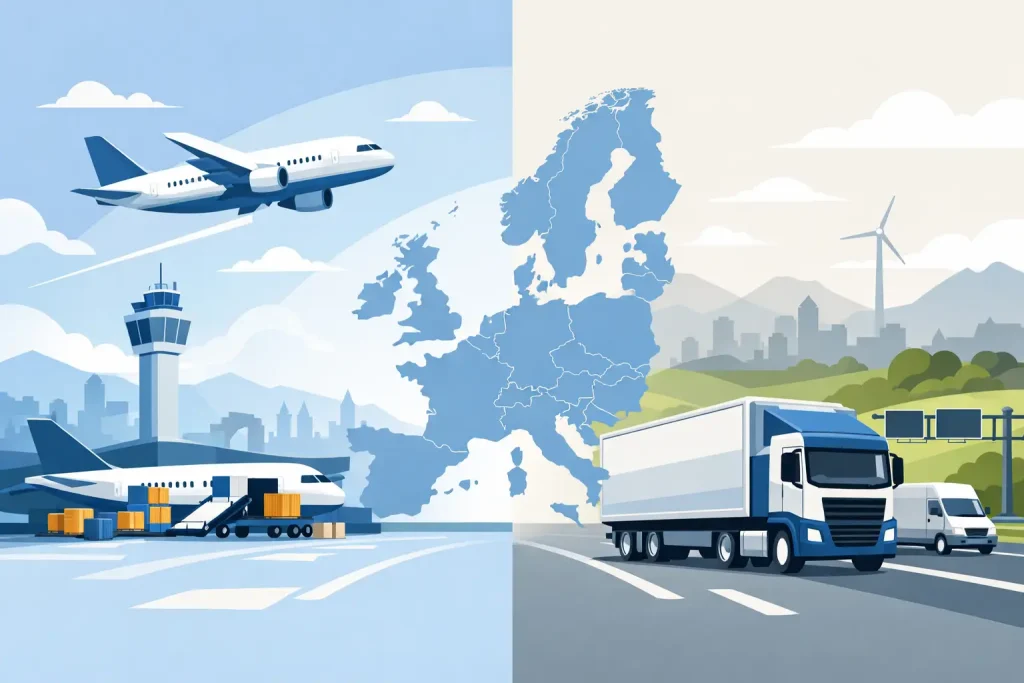
A delayed shipment from Milan to Frankfurt rarely fails because one mode is universally better than the other. It usually fails because the transport choice did not match the cargo, deadline, cost tolerance, or handoff complexity. That is the real question in air freight vs road freight within Europe: not which option sounds faster or cheaper in general, but which one gives you the highest control for this specific move.
For operations teams, procurement managers, and businesses moving goods across borders, the choice affects more than transit time. It shapes packaging requirements, documentation flow, damage risk, customs handling, pickup flexibility, and how quickly exceptions can be identified and corrected. If your priority is reliable execution, the best mode is the one that fits the shipment profile and keeps visibility high from dispatch to delivery.
Air freight vs road freight within Europe: the core difference
Air freight is built for speed across longer distances and for shipments where delay has a high business cost. Road freight is built for flexibility, broader cargo compatibility, and stronger cost efficiency on most intra-European lanes. That sounds simple, but the trade-offs matter.
Air often wins on line-haul speed. A shipment can cross Europe in hours once it is airborne. But airport handling, security screening, cut-off times, unloading, and final-mile trucking add time around the flight itself. The result is that air freight is not always as fast door-to-door as people assume.
Road freight usually moves slower in pure distance terms, yet it can be more direct. A truck can pick up at origin and deliver to destination with fewer handoffs, fewer terminal processes, and less repacking. For many European routes, especially regional and medium-distance ones, that directness can make road surprisingly competitive in real operational time.
When air freight makes operational sense
Air freight is the stronger option when urgency outweighs transport cost. If a production line is waiting on a critical component, if medical or high-value goods need accelerated movement, or if missed delivery would trigger contract penalties, air can protect a much larger business outcome.
It also fits cargo that is relatively light, compact, and valuable. Electronics, urgent spare parts, specialized components, and certain pharmaceutical products often justify the premium. In those cases, the cost of transport is only one line item. The true calculation includes downtime, lost sales, service disruption, and customer commitments.
Air freight can also simplify planning when a business needs a narrow delivery window and is willing to pay for that speed. But it requires discipline. Cut-off times are strict, packaging standards are tighter, and shipment data must be accurate early. If documents are incomplete or cargo is not properly prepared, the time advantage can disappear fast.
The limits of air freight
Air is less forgiving when freight is oversized, unusually shaped, hazardous, or heavy relative to its value. Capacity can tighten during peak seasons. Security procedures can add handling time. And the airport-to-airport segment is only part of the journey. You still need coordinated collection, terminal handling, and delivery at destination.
This is why experienced shippers look beyond the flight schedule. They ask whether the full chain can be controlled end to end, with tracking, exception management, and clear accountability at every transfer point.
When road freight is the better choice
Road freight is the practical default for a large share of European shipping because it balances cost, reach, and flexibility. It handles palletized freight, partial loads, full truckloads, temperature-sensitive goods, and many specialized transport requirements without forcing the shipment through airport infrastructure.
For businesses shipping regularly across Europe, road also supports better consolidation. Multiple consignments can move on planned routes, reducing unit cost while preserving service reliability. If your supply chain depends on repeat shipments rather than emergency moves, road often delivers the stronger long-term operating model.
Another advantage is accessibility. Trucks can reach industrial parks, warehouses, retail sites, and urban delivery points directly. That lowers handoff risk and often improves visibility, especially when supported by real-time GPS tracking and proactive status updates.
The limits of road freight
Road is vulnerable to traffic, border congestion, driver-hour regulations, weather, and weekend movement restrictions in some markets. Transit times can be harder to compress on long routes. If a shipment must move from Spain to Poland with minimal delay, road may not meet the required timeline without premium service design.
Road also becomes less attractive when the shipment is extremely urgent and the commercial cost of delay is high. In that case, lower freight spend can be a false economy.
Cost is not just the freight rate
Most comparisons between air freight vs road freight within Europe break down because they focus too narrowly on the quoted transport price. A lower rate does not always mean lower total cost.
Air freight usually carries the higher direct transport price. Road usually carries the lower one. But total landed decision-making should include warehouse dwell time, packaging adjustments, inventory carrying cost, customs brokerage needs where relevant, production impact, and the cost of missed deadlines.
For example, paying more for air may make sense if it prevents stockouts or keeps a customer launch on schedule. On the other hand, paying for air on non-urgent replenishment stock can quietly erode margins with no operational benefit.
The more disciplined approach is to separate shipments into categories: emergency, time-sensitive, scheduled, and cost-optimized. Once freight is grouped by business impact, the mode choice becomes clearer and more consistent.
Transit time depends on the whole journey
A common mistake is comparing airport transit time to truck transit time as if they were equivalent. They are not. What matters is door-to-door performance.
Air freight includes pickup, export handling, security processing, airport transfer, flight movement, import handling, customs steps when applicable, and final delivery. Road freight includes pickup, line-haul movement, possible cross-docking, border processes where required, and delivery. Each handoff adds risk and timing variability.
For shorter European lanes, road can be operationally cleaner because it removes terminal complexity. For longer lanes or urgent cross-continental moves, air can still produce the faster result even after accounting for handling time. The decision should be based on actual lane data, not assumptions.
Cargo type should drive the mode
The shipment itself often makes the decision for you. Fragile, high-value, low-weight cargo may align well with air. Bulkier or heavier goods usually fit road better. Temperature control, dangerous goods rules, stacking sensitivity, and packaging requirements also shift the balance.
If the cargo needs special handling equipment, site-specific delivery coordination, or direct truck access, road often offers better operational control. If the cargo is compact and the priority is speed with minimal inventory exposure, air may be the stronger option.
This is where process discipline matters. The right mode starts with accurate dimensions, weight, commodity details, and delivery constraints. Bad shipment data leads to bad mode decisions.
Visibility, documentation, and exception control
Reliable transport is not only about movement. It is about knowing what is happening while the shipment is in motion and having a clear process when something changes.
Road freight often offers strong continuous tracking because the vehicle remains linked to the shipment through most of the trip. Air freight can provide excellent milestone tracking, but it is more dependent on updates across multiple handlers and terminals. Neither mode is automatically more transparent. The real difference is how well the transport provider coordinates milestones, documents, and alerts.
For businesses managing frequent European shipments, this is where a connected operator adds value. A company like Alconedo can reduce coordination overhead by pairing mode selection with documented processes, real-time tracking, and 24/7 proactive support, so the transport plan stays visible instead of becoming a chain of separate handoffs.
So which should you choose?
Choose air when time is critical, the cargo is suitable, and the cost of delay is higher than the premium you will pay. Choose road when you need better cost control, direct delivery, more cargo flexibility, and a mode that fits recurring European distribution.
The real win is not picking one mode and using it for everything. It is building a repeatable decision model based on urgency, cargo profile, route length, delivery commitments, and risk tolerance. That is how businesses protect service levels without overspending.
If a shipment is truly urgent, move fast. If it is simply important, plan better. The strongest freight decision is the one that keeps your operation predictable before the shipment moves, not the one that sounds fastest after something has already gone wrong.
