
How Long Does Customs Clearance Take in Europe?
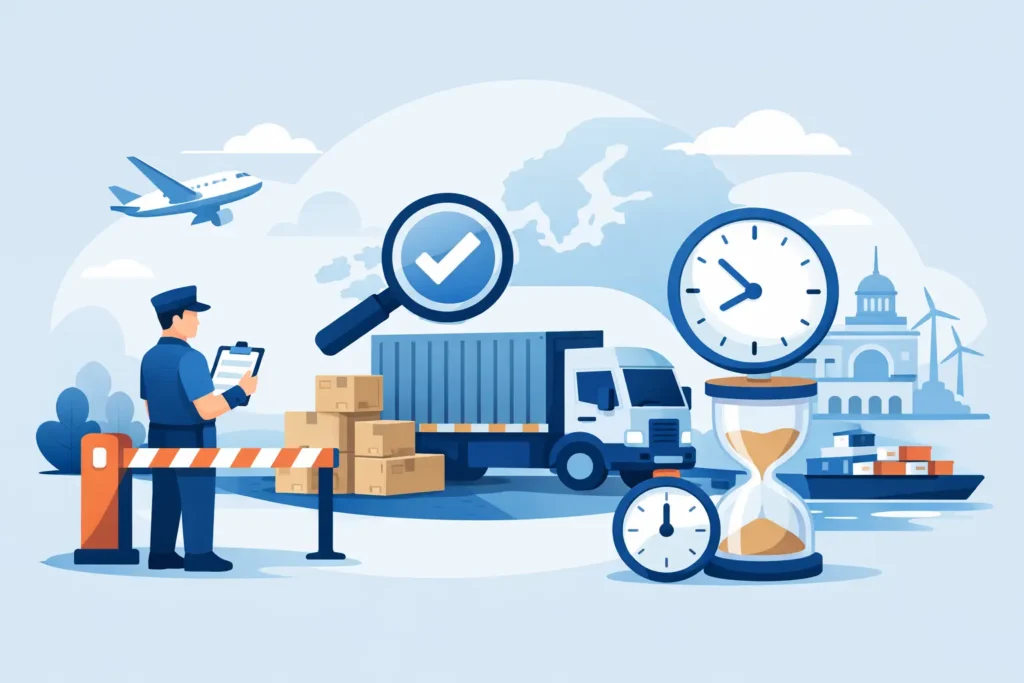
A truck can reach the border on schedule, the driver can be ready, and the consignee can be waiting – yet the shipment still pauses because customs is not working on the same clock as linehaul transport. That is why one of the most common planning questions in cross-border freight is simple: how long does customs clearance take in Europe? The honest answer is that it can take a few hours, a full day, or several days, depending on the shipment profile, the paperwork, and whether customs sees any reason to inspect more closely.
For operations teams, that timing difference matters. It affects delivery promises, warehouse slot planning, downstream production schedules, and customer communication. For individual senders, it affects when a parcel or personal shipment is actually available for delivery rather than just physically inside Europe.
How long does customs clearance take in Europe in real terms?
In straightforward cases, customs clearance in Europe may be completed within a few hours after arrival or document submission. A standard commercial shipment with complete and accurate paperwork, a clear product classification, and no inspection request often moves quickly.
A more typical working estimate is 1 to 2 business days. That is the range many shippers use for planning because it allows for document review, declaration processing, and coordination between the carrier, customs broker, and importer.
If customs flags the shipment for inspection, asks for missing information, or questions value, origin, or commodity code details, the process can extend to 3 to 5 business days or longer. In more complex cases, especially when regulated goods are involved, clearance may take a week or more.
So the practical answer is not one fixed number. It depends on whether the shipment is routine or whether customs has a reason to stop the flow and verify details.
Why customs timing varies across Europe
Europe is often discussed like one customs environment, but operationally it is more nuanced. EU customs rules create a shared framework, yet clearance speed still varies by country, port, airport, inland terminal, and shipment type.
An air freight consignment arriving at a major hub with digital pre-filing may clear faster than road freight reaching a busy land border during a congestion period. A parcel shipment handled through an optimized express network may move differently from palletized commercial freight that requires full import documentation and duty assessment.
There is also a difference between entry into the European Union and movement within it. Once goods are properly imported and released into free circulation, movement between many EU member states becomes much simpler. The real friction tends to happen at the point of import, not after the goods are already customs-cleared within the bloc.
That distinction matters for planning. A shipment going from Germany to France is not the same customs event as a shipment arriving from the US, China, Turkey, or the UK into the EU customs territory.
The biggest factors that affect clearance time
The first factor is document accuracy. Commercial invoice errors, missing EORI details, vague product descriptions, incorrect HS codes, and mismatched values are some of the most common reasons a shipment slows down. Customs works on declared data. If that data is incomplete or inconsistent, review takes longer.
The second factor is commodity risk. Electronics, food products, pharmaceuticals, chemicals, medical items, dual-use goods, and branded products often receive greater scrutiny than low-risk general merchandise. The more regulated the product, the more likely additional checks become.
The third factor is whether duties, taxes, and fees can be assessed without dispute. If customs needs clarification on valuation, country of origin, or whether preferential tariff treatment applies, release may pause until the importer or broker responds.
The fourth factor is inspection. Not every shipment is physically examined, but when one is selected, timing changes immediately. Physical inspection introduces handling delays, terminal coordination, and sometimes laboratory or agency review.
The fifth factor is volume pressure. Peak seasons, public holidays, labor shortages, and congestion at major gateways can all extend processing times even when documents are correct.
Customs clearance stages that add time
Clearance is not one single action. It is a chain of actions, and any weak point can add hours or days.
First comes document submission. In many cases, data is filed before the shipment arrives. That helps, but only if the submission is complete and accepted. Then customs reviews the declaration and determines whether the goods can be released immediately, require payment confirmation, or need further checks.
If duties and VAT apply, payment or guarantee arrangements must be in place. If another authority is involved, such as sanitary, veterinary, or safety controls, the shipment can move into a separate queue. Finally, once release is granted, the cargo still needs terminal release and onward transport coordination.
This is why a shipment may be described as “arrived” but still not be available for delivery. Arrival and customs release are not the same milestone.
What delays are most common?
Most customs delays are not dramatic enforcement cases. They are ordinary operational problems that could have been prevented earlier.
A vague invoice description like “parts” or “samples” often triggers questions because it does not tell customs what the goods actually are. Declaring the wrong Incoterm can create confusion around who is responsible for charges. Missing product certificates, origin statements, or import licenses can stop release entirely.
Another common issue is mismatch across documents. If the packing list, invoice, and transport record describe quantities or values differently, customs may hold the shipment until the discrepancy is resolved. Even timing matters. If the broker receives the final paperwork late, a same-day release window may be missed.
How to reduce customs clearance time in Europe
The fastest shipments are usually the ones prepared long before arrival. That means classifying goods correctly, using precise invoice descriptions, confirming importer details, and checking whether the product needs any additional permits or certificates.
It also helps to submit documents early and keep one clear owner for the customs file. When several parties are passing documents back and forth without control, delays become more likely. Businesses that move freight regularly benefit from a standardized document process and a single point of accountability for customs readiness.
Real-time visibility also matters. If a shipment is held, the issue should be identified immediately, not discovered hours later when a delivery slot has already been missed. That is where a transport partner with documented processes, tracking, and proactive support can make a practical difference. The shipment may still face a customs question, but the response cycle becomes faster and more controlled.
Road freight, air freight, and parcel traffic do not clear at the same speed
Air freight often clears faster because documentation is typically transmitted early and the handling systems are built for speed. That does not mean air cargo avoids customs delays, only that the process can be tighter when the paperwork is right.
Road freight timing depends heavily on border route, terminal workload, and the complexity of the cargo. Groupage shipments can take longer than dedicated loads because multiple consignments may need separate customs treatment.
Parcel networks can also move quickly for standard consumer goods, but that speed drops if the declared value is unclear, if the goods are restricted, or if import taxes are not settled smoothly. For high-volume e-commerce flows, the system is efficient. For unusual or poorly documented items, it is not.
A practical planning range for shippers
If you need a usable planning benchmark, assume the following. A clean, low-risk shipment may clear the same day or within 24 hours. A standard commercial shipment should usually be planned with 1 to 2 business days. A shipment with inspection risk, document issues, or regulated goods should be planned with at least 3 to 5 business days, sometimes longer.
That range is more operationally honest than promising a single fixed timeline. Customs is partly predictable and partly conditional. Good process control improves speed, but it does not eliminate every variable.
For businesses shipping into or across Europe, the best approach is to treat customs clearance as a managed checkpoint, not an afterthought. If the documents are right, the data is filed early, and status is visible in real time, you gain control over the part of the journey that causes the most uncertainty. That is exactly where disciplined transport coordination matters most – not when everything goes perfectly, but when timing is under pressure and every hour affects the next move.
