
FTL vs LTL Cost Comparison That Holds Up
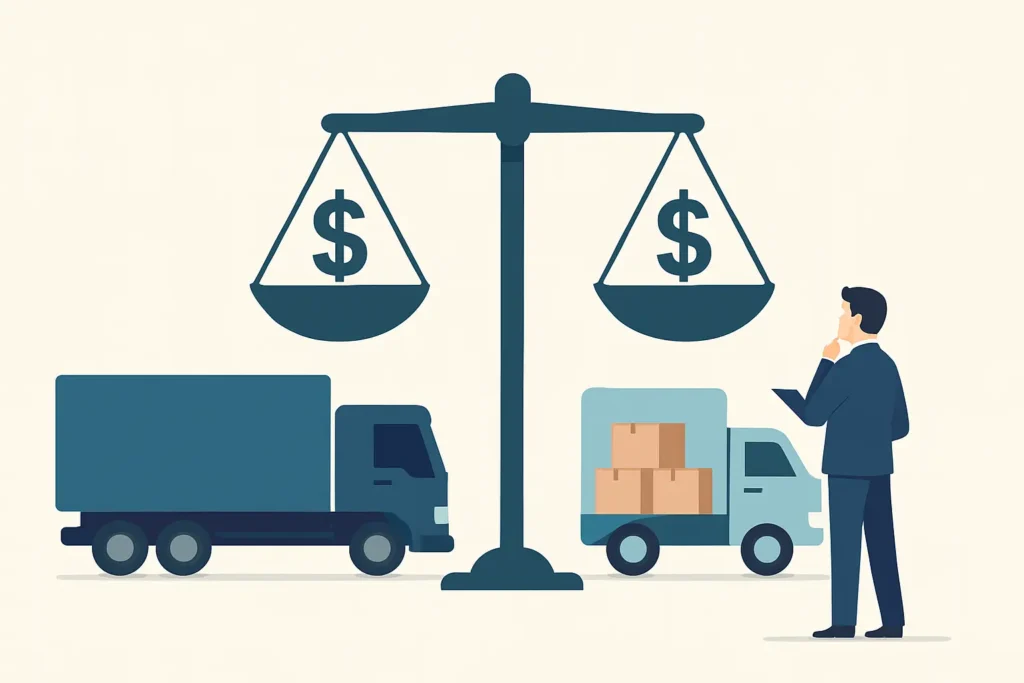
Your freight budget usually doesn’t get blown up by the rate you chose. It gets blown up by the rate you chose plus the delays, handling, claims, detention, and internal time spent chasing status.
That’s why an ftl vs ltl cost comparison has to be about total cost and operational risk, not just “which quote is lower.” Below is a practical way to evaluate both options using the cost drivers carriers actually price against, the shipment conditions that quietly flip the math, and the break-even scenarios that show up in real operations.
FTL vs LTL cost comparison – what you’re actually paying for
Full Truckload (FTL) is the purchase of capacity. You’re paying to reserve an entire trailer and a single linehaul movement. The carrier prices you based on lane demand, equipment type, distance, and time sensitivity, and then largely leaves your freight alone from pickup to delivery.
Less-Than-Truckload (LTL) is the purchase of space inside a network. You’re buying a portion of a trailer and paying for the carrier’s terminal handling, consolidation, and linehaul between hubs. The quote reflects the carrier’s cost to touch, classify, and route your pallets through that network.
The immediate consequence: FTL is often simpler and more predictable, while LTL can be cheaper for small shipments but adds handling and scheduling complexity that has a real price when something goes sideways.
The pricing mechanics that determine which one is cheaper
How FTL is typically priced
FTL rates tend to be all-in per truck (or per mile) plus accessorials. The major variables are distance, lane balance (backhaul vs headhaul), seasonality, equipment needs (dry van, reefer, flatbed), and pickup and delivery windows.
In practice, FTL is the cleanest model: one pickup, one delivery, minimal touches. If your dock schedule is tight, this simplicity becomes a cost lever because fewer steps means fewer opportunities for detention and missed appointments.
How LTL is typically priced
LTL pricing is built on freight class, weight, dimensions, density, and handling. The carrier is estimating how much cube you consume, how efficiently the pallet can be stacked, and how costly it is to move through a terminal system.
Two shippers can move the same weight and pay wildly different rates if one has dense, stackable freight and the other ships bulky, fragile items that can’t be double-stacked. That’s why “cheaper per pound” is not a reliable benchmark for LTL.
The break-even question: when does LTL stop being cheaper?
Most teams look for a magic weight threshold, but weight alone is only a proxy. What matters is: how much trailer space you consume and how risky the LTL handling profile is for your product.
A useful operational rule is to start running a true comparison when you’re shipping 6-10 standard pallets or when your shipment is consistently above roughly 8,000-12,000 pounds. Depending on lane and market conditions, that’s where LTL can approach the cost of reserving a truck, especially after you add accessorials like liftgate, limited access, or inside delivery.
Another break-even trigger is time. If the LTL network adds 1-3 days of transit or increases variance, the inventory carrying cost and the downstream cost of missed production or missed retail appointments can eliminate the upfront savings.
Cost drivers that tilt the comparison fast
1) Handling and claims exposure
LTL freight is touched multiple times: at origin terminal, cross-dock transfers, and destination terminal. Each touch adds labor cost for the carrier, and it also increases the chance of pallet damage, crushed corners, or missing pieces.
FTL is typically one load, one unload. If you ship high-value or damage-sensitive goods, the hidden cost of claims and rework can be more important than the rate difference.
2) Appointment requirements and dock constraints
Both modes can require appointments, but LTL tends to be more constrained because it depends on terminal routes and delivery windows. If your receiving team is strict or your location is difficult (tight urban access, security check-ins, limited receiving hours), LTL re-deliveries and wait time can become expensive.
FTL can be scheduled more directly. If your plant or warehouse depends on precise receiving slots, the controllability of FTL often reduces downstream costs.
3) Accessorials that accumulate quietly
Many of the “surprises” in an LTL invoice are accessorials: reclassification, reweigh, address correction, residential delivery, liftgate, limited access, or appointment delivery.
FTL accessorials exist too (detention, layover, truck ordered not used), but they’re usually easier to forecast because the move is more direct and the shipment specs are less likely to be challenged after pickup.
4) Packaging and pallet quality
If your pallets are weak, overhang, or are not banded and wrapped well, LTL becomes riskier because the freight has to survive terminal handling. Many shippers spend more on packaging to make LTL viable, which is legitimate cost that belongs in your comparison.
With FTL, you can sometimes use simpler unitization because there’s less handling. That can reduce labor at shipping and lower packaging material costs.
5) Volume consistency
If you ship the same lanes weekly, FTL often becomes easier to optimize through consistent carrier capacity, routing guide discipline, and predictable appointment patterns.
If your shipments are sporadic and small, LTL’s shared network can be financially efficient. You’re paying for flexibility, not owning the whole trailer.
Total cost: what to include so you don’t fool yourself
A quote-to-quote comparison misses the biggest drivers of total landed cost. When you model FTL vs LTL, include the operational costs that hit your P&L even if they don’t show up on a freight invoice.
At minimum, factor in your internal labor for booking, paperwork, and exception management. LTL exceptions can take more time: correcting class, disputing reweighs, chasing terminal updates, and coordinating re-deliveries.
Also include the cost of time. If LTL adds transit variability, you may hold more safety stock or pay more for expediting. Conversely, if FTL helps you run leaner inventory and tighter production schedules, that operational gain is real money.
Use-case scenarios that clarify the decision
Scenario A: 2 pallets, dense freight, flexible delivery
This is classic LTL territory. If your freight is dense and stackable, your class stays low, and you’re not paying for special services, LTL usually wins on rate.
Where it can fail is when the receiving location triggers accessorials, or when you under-spec the shipment (dimensions, NMFC item, or packaging) and get hit with a reclass.
Scenario B: 8 pallets, time-sensitive, appointment delivery
This is the gray zone. LTL may still quote lower, but the moment you need tight control over delivery day and time, the risk premium increases. If a missed appointment creates a fee or delays a production line, FTL often becomes the cheaper total-cost option even if the linehaul rate is higher.
Scenario C: 12-16 pallets, high value, damage sensitive
FTL is frequently the more defensible choice here. The cost difference between “most of a trailer” and “all of a trailer” can be smaller than expected, and the reduction in touches can lower claims exposure. You also gain simpler tracking and fewer handoffs.
Scenario D: Frequent smaller drops to multiple consignees
Neither pure FTL nor pure LTL is automatically best. Multi-stop truckload can work, but stops add cost and time. LTL can work, but multiple deliveries amplify accessorial risk.
This is where coordination and visibility matter more than the mode itself: you need clear shipment specs, documented processes, and tracking that your team can rely on to manage multiple receivers.
A practical way to run your own comparison
Start with one lane and one month of shipping history. Identify a representative set of shipments: weights, pallet counts, dimensions, accessorial needs, and delivery requirements.
Then price each shipment in both modes using the same service expectations. Don’t compare an economy LTL quote to an expedited FTL commitment. Align transit and delivery windows as closely as possible.
Finally, add the “shadow costs” that your team knows are real: average claims rate by product type, average exception hours, typical appointment fees, detention exposure, and the value of a day of inventory for that SKU. Even rough estimates are better than pretending those costs don’t exist.
If you want the comparison to hold up in procurement reviews, document assumptions in plain language: what you assumed about packaging, stackability, receiving hours, and appointment rules. Those details are usually where savings claims fall apart.
Where technology and process make the biggest difference
The best-mode choice becomes obvious faster when you have clean shipment data and reliable status visibility. Accurate dimensions and weights reduce LTL reclass exposure. Consistent pickup and delivery processes reduce detention and missed appointments in FTL.
Real-time tracking also changes behavior. When teams can see where freight is, they spend less time emailing for updates, and they can intervene earlier when a delivery window is at risk. That time savings is not just convenience – it’s fewer exceptions, fewer chargebacks, and fewer last-minute premium shipments.
If you’re managing freight alongside corporate travel and local courier needs, consolidating movement oversight under one operational umbrella can reduce coordination overhead. For organizations that want that kind of control across freight, travel, and last-mile delivery, Alconedo coordinates these needs through a single platform approach at https://www.alconedo.com.
The decision rule that rarely fails
Choose LTL when your shipment is genuinely small, stable in class and dimensions, and tolerant of network transit variability. Choose FTL when your shipment is large enough to consume meaningful trailer space, is time-sensitive, is damage-sensitive, or when a missed appointment has a measurable downstream cost.
Then pressure-test your choice by asking one question: if this shipment goes wrong, which mode creates a bigger operational mess for your team? The right answer is usually the cheaper answer in the real world.
Closing thought: the strongest cost advantage doesn’t come from picking FTL or LTL once – it comes from building a repeatable decision process that turns every shipment into a controlled, trackable outcome.
