Why Real Time Shipment Updates Matter
A shipment that goes quiet for six hours creates work fast. Operations teams start chasing carriers, customer service starts fielding status requests, and the consignee starts adjusting labor, dock time, or installation plans without reliable information. That is why real time shipment updates are no longer a nice-to-have. They are an operational control tool.
For businesses moving freight across borders, for travelers coordinating baggage, transfers, or time-sensitive equipment, and for local customers sending urgent parcels, visibility changes how decisions get made. When location, status, and delivery progress are current and accessible, problems are smaller, communication is cleaner, and service promises are easier to keep.
What real time shipment updates actually do
At a basic level, real time shipment updates tell you where a shipment is and whether it is moving according to plan. In practice, they do more than that. They reduce uncertainty between milestones that used to be operational blind spots.
A traditional update model might confirm pickup, note a hub scan, and then show final delivery. That leaves long periods where customers and coordinators are guessing. A real-time model fills those gaps with GPS-based movement data, driver or carrier status changes, exception alerts, and estimated arrival windows that adjust as conditions change.
That matters because logistics decisions are rarely made at the exact moment of dispatch or delivery. Most of the work happens in between. A warehouse needs to know whether to hold a dock. A project manager needs to know whether materials will arrive before a crew does. A traveler waiting on a local courier needs to know whether to stay put or leave instructions. Visibility supports those decisions while there is still time to act.
Why real time shipment updates improve control
Control in logistics does not mean preventing every delay. It means seeing conditions early enough to respond intelligently. That is the real value.
If a truck is delayed at a border crossing, a static tracking page is not very useful. An operations team needs a current status, a revised ETA, and enough confidence in the data to update downstream plans. If a local parcel driver is running behind due to traffic, the recipient needs a delivery window that reflects actual road conditions, not the original dispatch estimate.
This is where real time shipment updates become operationally meaningful rather than cosmetic. They support reallocation of labor, updated customer communication, appointment rescheduling, and escalation when a shipment is at risk. For high-value cargo, temperature-sensitive goods, or urgent documents, even a small time advantage matters.
For procurement teams and logistics coordinators, better control also means fewer manual interventions. Instead of calling for status checks throughout the day, teams can monitor progress directly and focus their time on exceptions. That lowers coordination overhead, which is often one of the hidden costs in fragmented transport operations.
The business case is bigger than customer convenience
Customer experience is part of the story, but it is not the whole story. Real time shipment updates also improve internal performance.
First, they reduce avoidable communication loops. When customers, internal stakeholders, and receiving teams can see shipment progress clearly, there are fewer status emails, fewer check-in calls, and fewer duplicated updates from different departments.
Second, they improve planning accuracy. Current location data and reliable ETAs help businesses schedule labor, inventory intake, installation, and handoffs more precisely. That is especially useful in cross-border transport, where customs timing, route conditions, and regional handover points can affect the final schedule.
Third, they create accountability. When tracking is documented in near real time, service performance becomes easier to measure. You can compare planned movement against actual movement, identify recurring bottlenecks, and hold partners to defined standards.
There is a trade-off, though. More data does not automatically mean better decision-making. If updates are delayed, inconsistent across carriers, or presented without context, teams can end up with noise instead of clarity. The quality of the tracking process matters as much as the existence of tracking itself.
Where real time shipment updates matter most
Not every shipment needs the same level of monitoring. A low-value, non-urgent delivery with broad timing flexibility may not require minute-by-minute visibility. But in many common scenarios, the benefit is immediate.
Cross-border freight is one of them. Border procedures, customs checks, carrier handoffs, and route variability create more points where a shipment can slow down or change status. Real-time visibility helps both the shipper and the consignee adjust quickly when conditions shift.
Specialized cargo is another. If a shipment has handling requirements, scheduled unloading resources, or downstream dependencies, timing errors are expensive. A missed arrival estimate can affect equipment allocation, site access, and customer commitments.
Local courier deliveries also benefit. People expect app-based control when they send a parcel across town. They want to know when pickup is complete, whether the driver is on the way, and when delivery has been confirmed. In this context, real time shipment updates are not a premium feature. They are part of the expected service standard.
What good shipment visibility looks like
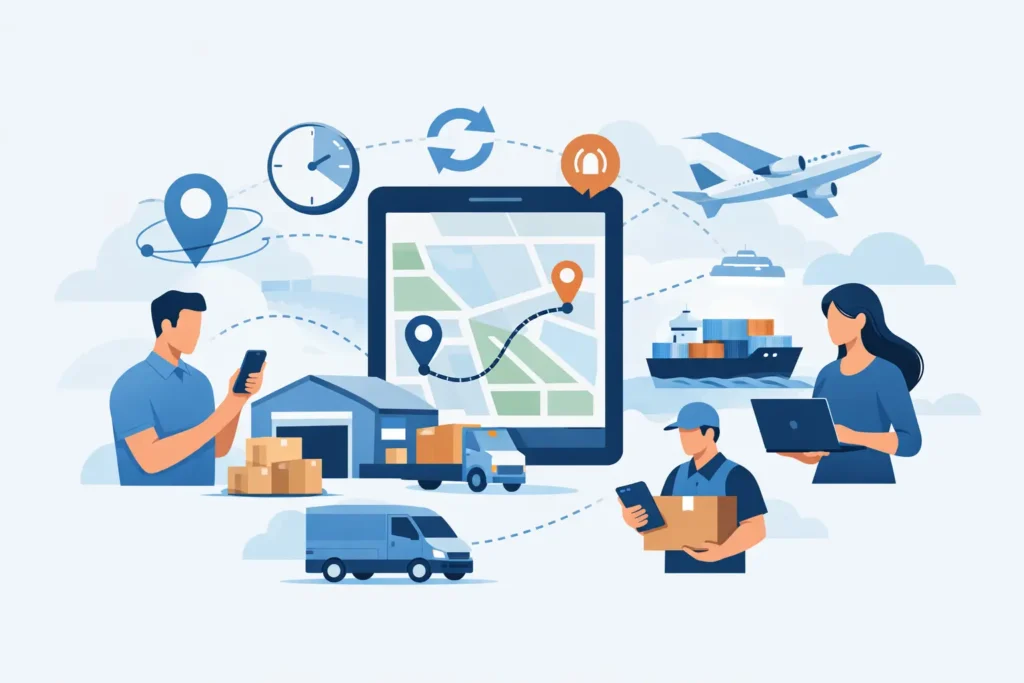
A useful tracking experience is clear, current, and actionable. It should show more than a pin on a map.
At minimum, customers should be able to see pickup confirmation, current transit status, estimated arrival timing, and proof of delivery once completed. For business users, that often needs to go further, including milestone records, exception notifications, and shipment documentation tied to the movement itself.
Good visibility also distinguishes between certainty levels. There is a difference between a planned ETA, a dynamically recalculated ETA, and a confirmed arrival appointment. If everything is presented with the same confidence level, teams may act on assumptions that are weaker than they appear.
The interface matters too. A clean mobile view works for an individual waiting on a courier, while an operations team may need a broader dashboard across multiple live shipments. The underlying principle is the same: reduce effort to get the current truth.
The role of proactive support
Tracking is powerful, but it does not replace service. When exceptions happen, customers need more than a status label.
A shipment marked delayed is only useful up to a point. The next questions are obvious: Why is it delayed, what is the revised expectation, and what action is being taken? The best service models combine real-time map tracking with proactive support that interprets the situation and communicates next steps.
This is particularly important for business-critical freight and cross-functional movement planning. A logistics coordinator does not just need raw data. They need confidence that someone is managing the issue, documenting the event, and protecting the delivery commitment where possible.
That balance between self-service visibility and responsive human support is where an integrated operator can stand out. Alconedo applies that principle across transport, travel, and local delivery by combining tracking visibility with 24/7 proactive support and documented processes, so customers are not left translating fragmented updates on their own.
Real time shipment updates and trust
Trust in movement services comes from evidence. Promises matter, but visible execution matters more.
When a customer can see that pickup occurred on time, that transit is progressing as expected, and that any exception is acknowledged quickly, confidence builds. That confidence carries into the next booking. It also affects whether customers consolidate more of their movement needs with one provider instead of managing separate vendors for freight, urgent parcel delivery, and related travel coordination.
There is also a practical trust benefit inside organizations. Procurement teams and operations managers are more likely to standardize around providers that make performance visible. Reporting becomes easier, customer-facing teams are better informed, and service claims are easier to verify.
That said, trust can be damaged if real-time updates overpromise. A flashy map cannot compensate for inaccurate status data or weak exception handling. Visibility has to be backed by disciplined operations, vetted carriers or drivers, and documented handoffs.
Choosing a provider with real visibility
If you are evaluating transport or delivery services, ask a simple question: when something changes mid-route, how quickly will I know, and what can I do with that information?
That question gets past marketing language. It focuses on whether the provider offers current, usable updates tied to actual execution. You want tracking that reflects movement as it happens, alerts that surface exceptions early, and support that takes responsibility when the route does not go as planned.
For businesses, that means less time spent chasing status and more time managing outcomes. For individuals, it means fewer missed deliveries, clearer timing, and better control from pickup to handoff. In both cases, the value is the same. Better visibility reduces friction.
Movement is easiest to manage when it is not fragmented into guesswork, callbacks, and delayed answers. The best shipment experience is not just fast. It is visible enough that people can act with confidence while the shipment is still moving.
