
What Is Proof of Delivery in Logistics?
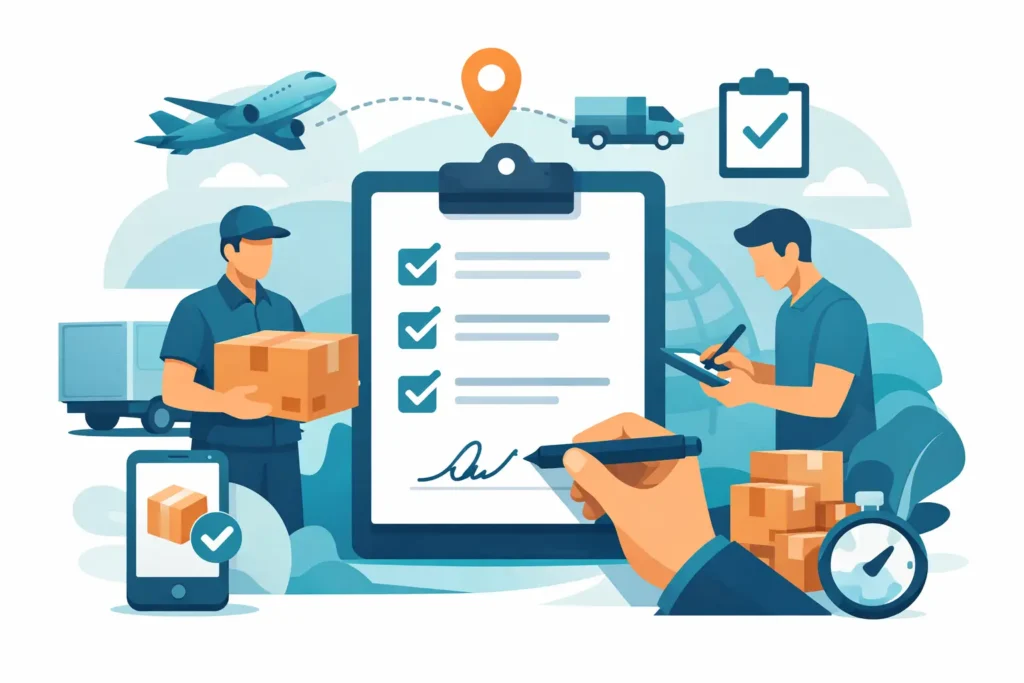
A shipment shows as delivered on the route screen, but the customer says nothing arrived. That is the moment proof of delivery stops being a routine document and becomes a control point. If you manage freight, parcels, or time-sensitive deliveries, understanding what is proof of delivery in logistics matters because it affects billing, claims, customer trust, and how quickly your team can resolve exceptions.
What is proof of delivery in logistics?
Proof of delivery, often shortened to POD, is the record that confirms a shipment reached the intended recipient at the agreed destination. In logistics operations, that record usually includes the delivery date and time, recipient details, shipment reference, and some form of confirmation such as a signature, photo, barcode scan, PIN code, or GPS-stamped event.
At a basic level, POD answers one question: was the shipment delivered? In real operations, it usually answers several more. Who accepted it? When exactly was it handed over? Was the package left at a dock, reception desk, doorstep, or warehouse bay? Was there visible damage? Was the quantity correct? Those details are what turn a delivery event into usable operational evidence.
That is why POD is not just paperwork. It is part of the chain of accountability between shipper, carrier, consignee, and customer service teams.
Why proof of delivery matters beyond confirmation
A delivery confirmation without detail is often not enough when something goes wrong. A customer may dispute receipt, a finance team may hold an invoice, or a warehouse may claim a short shipment. Proof of delivery gives operations teams a documented basis for response instead of relying on driver memory or manual follow-up.
For businesses, the biggest value is control. POD supports faster invoicing, cleaner handoffs, fewer unresolved disputes, and better customer communication. When supported by real-time tracking, it also closes the visibility gap between “out for delivery” and “completed delivery.”
There is also a compliance angle. In some sectors, especially higher-value freight, regulated goods, medical shipments, or cross-border transport, delivery records are part of audit readiness. The exact POD requirement depends on the cargo, the contract terms, and the destination market. A signed note might be enough for one shipment and completely inadequate for another.
What information is usually included in a POD?
A strong proof of delivery record is specific enough to verify the event and useful enough to support follow-up. Most PODs include the shipment or consignment number, delivery address, date, time, recipient name, and driver or carrier reference.
In digital systems, the record may also include GPS coordinates, a timestamp generated automatically in the app, photos of the delivered item, a signature captured on a handheld device, or notes about delivery conditions. If there was a problem such as damaged packaging, a refused shipment, or partial delivery, that should be recorded at the same point.
The right level of detail depends on risk. For low-value same-day parcels, speed may matter more than a handwritten signature. For specialized cargo or business-critical inventory, the delivery record needs to be tighter and harder to challenge.
Types of proof of delivery in logistics
Paper POD
The traditional model is a printed delivery note signed by the recipient. It still exists, especially in legacy transport environments or where internet access is unreliable. Paper POD can work, but it is slower to process, easier to lose, and harder to match against route data in real time.
Electronic proof of delivery
Electronic proof of delivery, often called ePOD, captures delivery confirmation through a mobile app, handheld scanner, or driver device. This is now the standard for many modern logistics operations because it improves speed, accuracy, and visibility.
An ePOD can combine multiple data points in one event: timestamp, recipient signature, geolocation, photo evidence, and status updates synced instantly to the transport management system. That makes it much easier to support customers proactively instead of chasing documents after the fact.
Contactless POD
Some deliveries do not require a physical signature. Instead, confirmation may come from a delivery photo, secure location note, one-time PIN, or app acknowledgment. This approach is common in residential delivery and urgent local courier workflows.
It is efficient, but there is a trade-off. Contactless methods are faster, yet they can be more exposed to disputes if the delivery environment is uncontrolled or the handoff point is ambiguous.
How proof of delivery fits into the logistics workflow
POD sits at the end of the transport leg, but its value begins much earlier. If the shipment data is incomplete at dispatch, the delivery record will also be weak. Good POD starts with accurate order information, correct addresses, clear delivery instructions, and the right service level.
Once the driver reaches the stop, the POD event documents the handoff. After that, the record flows into customer notifications, billing processes, performance reporting, and claims handling. In other words, POD is not just an endpoint. It connects transport execution with customer service, finance, and operational analytics.
For cross-border freight, the workflow may be more layered. Customs documentation, consignee checks, scheduled receiving windows, and special cargo conditions can all affect what counts as acceptable delivery confirmation. A simple signature may not cover the full operational requirement.
What good proof of delivery looks like
A good POD is timely, accurate, and difficult to dispute. Timely means it is captured at the actual handoff, not reconstructed later. Accurate means the shipment reference, recipient details, and exception notes match the physical delivery. Difficult to dispute means the record includes enough evidence to stand up in customer service, finance, or claims review.
That usually points toward digital capture. If a driver scans the shipment, records the time automatically, captures a signature or photo, and syncs the update instantly, the business has a much stronger operational position. If the same event is written on paper and uploaded hours later, confidence drops.
This is where technology changes the quality of execution. Real-time GPS tracking and documented delivery events give both shippers and recipients better visibility. For businesses handling urgent freight, repeat B2B deliveries, or local parcel movements, that visibility reduces friction at every stage.
Common POD problems and why they happen
Not all delivery disputes come from failed delivery. Many come from weak documentation. A missing recipient name, unreadable signature, delayed data entry, or incorrect address can make a completed delivery look uncertain.
Another common issue is mismatch between service model and proof standard. A route designed for high-volume residential drop-offs may not produce the same level of POD evidence as a controlled B2B freight handoff. If expectations are not aligned upfront, disputes increase even when drivers perform correctly.
There is also the human factor. Drivers under time pressure may skip notes, take poor photos, or select generic status codes. That is why POD quality depends on process design, driver training, and the tools used in the field, not just policy.
Why ePOD is becoming the operational standard
If your operation depends on speed, transparency, and exception control, electronic proof of delivery has clear advantages. It reduces manual admin, accelerates document availability, and gives customer-facing teams immediate access to the same delivery record the driver captured in the field.
It also improves performance management. You can measure delivery completion times, identify failed handoff patterns, and review route-level issues with actual timestamped evidence. That turns POD from a defensive document into a source of operational insight.
For companies managing transport across multiple movement types, from freight to local courier delivery, consistent digital POD standards help simplify coordination. That is one reason integrated providers such as Alconedo focus on visibility tools and documented processes across transport execution.
Choosing the right proof of delivery approach
The best POD method depends on what you move, who receives it, and how much risk sits in the handoff. High-value freight may require signature capture, ID verification, and condition notes. Local parcel delivery may work well with photo confirmation and app-based updates. Scheduled business deliveries often need named recipients and receiving timestamps tied to dock procedures.
The key is to avoid one-size-fits-all thinking. Strong logistics control comes from matching the delivery proof standard to the shipment profile. If the proof is too light, disputes rise. If it is too heavy, delivery speed suffers and drivers spend more time documenting than moving.
A practical approach is to define POD rules by service type, train drivers to those standards, and make the record visible to customer support as soon as the stop is completed. That balance supports both accountability and pace.
Proof of delivery is not glamorous, but it is one of the clearest indicators of whether a logistics operation is actually under control. When the handoff is documented properly, teams spend less time arguing about what happened and more time moving the next shipment forward.
