
Dedicated Van vs Groupage Road Freight
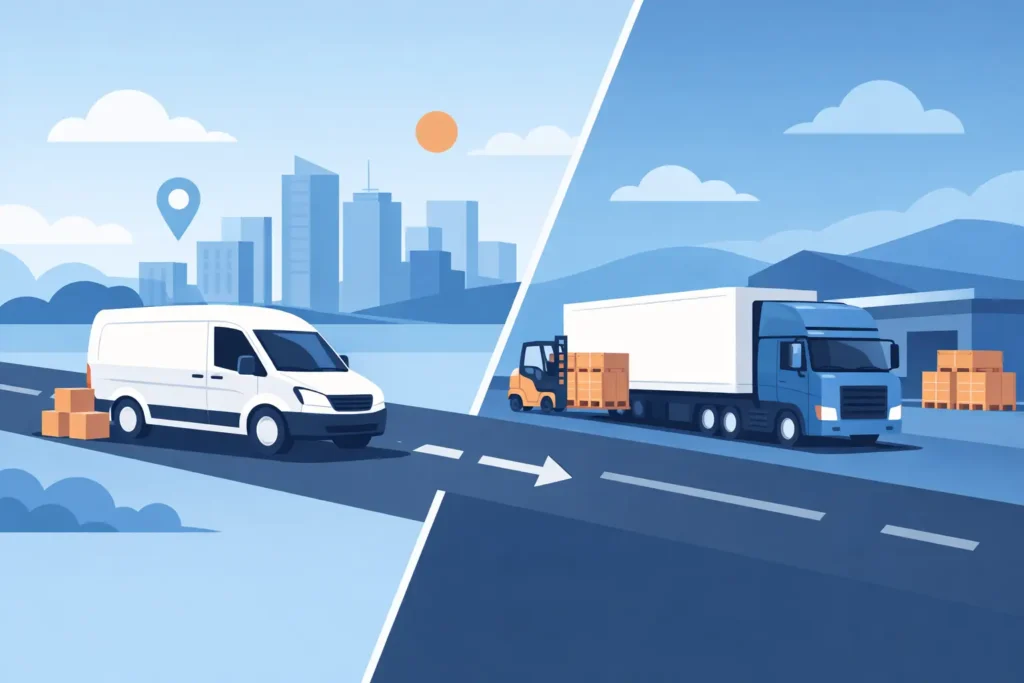
When a shipment has to cross Europe on a fixed deadline, the choice between dedicated van vs groupage road freight is not a pricing detail. It changes transit time, handling risk, delivery flexibility, and how much control your team keeps from pickup to proof of delivery. For operations managers and procurement teams, that decision affects service levels, customer commitments, and internal workload just as much as transport spend.
Both options have a valid place in road logistics. The right one depends on what you are moving, how urgent it is, how sensitive it is to handling, and what level of visibility your business needs. If you choose based on rate alone, you can easily create higher downstream costs through delays, extra touches, missed booking slots, or avoidable claims.
What dedicated van and groupage actually mean
A dedicated van is a vehicle assigned to one shipment or one customer movement. The cargo is picked up and delivered directly, without being combined with other shippers’ freight in the same transport plan. In practice, that usually means fewer stops, fewer handovers, and a tighter delivery window.
Groupage road freight works differently. Your goods share trailer or vehicle space with freight from other customers moving on similar lanes. The carrier consolidates loads through a hub, terminal, or planned network route, then deconsolidates them for final delivery. This model is efficient for non-urgent cargo, especially when shipment volumes do not justify a full dedicated vehicle.
The operational difference is simple. Dedicated van prioritizes speed and control. Groupage prioritizes network efficiency and lower unit cost.
Dedicated van vs groupage road freight: the real trade-off
The most common mistake is treating this as a simple fast-versus-cheap comparison. Cost matters, but the better comparison is certainty versus consolidation.
With a dedicated van, the route is built around your shipment. Pickup can usually happen faster, delivery windows are narrower, and special handling instructions are easier to maintain because fewer parties touch the cargo. If your customer is waiting for parts to restart production, if a trade event has a strict receiving cutoff, or if medical or high-value items need close control, dedicated transport usually earns its higher rate.
With groupage, the logic is different. You pay for the space you use rather than the full vehicle. That can make it the smarter commercial option for palletized goods, standard cartons, routine replenishment, and shipments where a broader delivery window is acceptable. The savings are real, but so is the dependency on terminal schedules, load planning, and multi-stop routing.
In other words, dedicated transport buys urgency and control. Groupage buys efficiency, provided your shipment can tolerate more process steps.
When a dedicated van is the better decision
A dedicated van makes sense when time is commercially critical, not just convenient. Manufacturers use it for line-down situations, distributors use it for late order recovery, and project teams use it when installation crews or site access windows cannot move.
It is also a strong fit when handling risk needs to stay low. Fragile items, prototypes, trade show materials, regulated samples, and goods with strict chain-of-custody expectations benefit from direct movement. Fewer transfers usually means fewer chances for loss, misrouting, or damage.
There is also a documentation and communication advantage. Because the movement is simpler, status reporting tends to be cleaner. Real-time GPS visibility is easier to interpret when one vehicle is assigned to one job, and exception management is more direct when there is no consolidation network involved. For teams that need precise updates for customers, sites, or internal stakeholders, that matters.
Still, dedicated does not automatically mean best. If the freight is not time-sensitive and the cargo value is moderate, paying for a full direct vehicle can be unnecessary. Speed has a cost, and sometimes it is a cost your operation does not recover.
Signs you are paying too much for dedicated transport
If your team repeatedly books dedicated vans for routine stock transfers, flexible replenishment, or freight that sits in a receiving area for a day before processing, you may be buying urgency you do not use. The shipment feels important, but the supply chain does not actually require direct service.
That is where disciplined planning helps. The question is not whether a dedicated van is better in absolute terms. It is whether the business impact of a delay is greater than the premium for a direct vehicle.
When groupage road freight is the stronger option
Groupage is often the right answer for stable, repeatable flows. If your business ships smaller consignments on regular lanes and can work with structured cutoff times, consolidation can reduce transport cost without creating operational pain.
It also supports better vehicle utilization. Instead of paying for unused capacity in a dedicated van, you share that capacity with other shipments. For procurement teams managing transport budgets across many movements, that can materially improve cost control.
For standard commercial freight, groupage can be entirely appropriate. Palletized consumer goods, boxed spare parts, retail replenishment, and low-risk industrial materials often move well through consolidated networks. As long as packaging is suitable for multi-handling and delivery windows are realistic, the model works.
The trade-off is that your shipment becomes one part of a larger system. Cutoff times are less flexible. Routing may involve terminals. Delivery timing is shaped by network planning, not just your customer request. If something slips upstream, recovery can be slower than with a direct van because multiple shipments and schedules are connected.
Where groupage can create hidden costs
The lower rate can be offset if your cargo is sensitive to handling, if labeling is inconsistent, or if the consignee has tight booking procedures. A missed warehouse slot, a re-delivery fee, a damaged pallet, or a delay that triggers customer penalties can quickly erase the savings.
That does not mean groupage is risky by default. It means groupage rewards good preparation. Accurate dimensions, strong packaging, clear documents, and realistic delivery expectations are not administrative extras. They are what make consolidated freight efficient.
The four factors that should decide the mode
The best transport choice usually comes down to four operational variables: urgency, cargo profile, delivery constraints, and visibility requirements.
Urgency is the first filter. If a shipment must move immediately and arrive on a narrow window, dedicated van is usually the safer path. If delivery can land within a broader scheduled range, groupage becomes viable.
Cargo profile is next. High-value, fragile, irregular, or sensitive items often justify direct movement because each additional touch increases exposure. Standard pallet freight with durable packaging is generally better suited to consolidation.
Delivery constraints matter more than many teams expect. Construction sites, event venues, hospitals, production facilities, and secure locations often have strict appointment rules. Direct transport handles those constraints better because the route is simpler and more adaptable.
Then there is visibility. Some shipments only need milestone updates. Others require live tracking, proactive exception alerts, and precise ETAs that internal teams can share with customers or site managers. Dedicated moves generally support that level of control more cleanly.
Dedicated van vs groupage road freight for cross-border moves
Cross-border shipments raise the stakes because delays do not always happen on the road. They can happen in paperwork, customs coordination, local delivery rules, or terminal processing. That is why the dedicated van vs groupage road freight decision should include administrative complexity, not just distance.
Dedicated transport can reduce friction when documents must stay tightly aligned with one shipment and one route. It simplifies coordination and can make timing more predictable, especially for urgent cross-border consignments.
Groupage still works well internationally, but it depends on disciplined network execution. If your freight is moving through a consolidation model across borders, every label, document, and shipment instruction needs to be right the first time. Otherwise, delays can multiply across the chain.
This is where a provider with clear process control, real-time tracking, and proactive support adds value beyond the truck itself. Alconedo Transport is built around that operating model – reducing coordination overhead while keeping shipment status visible and documented from pickup through delivery.
How to make the right call each time
A practical rule helps. Choose dedicated when delay is expensive, handling risk is high, or delivery precision is non-negotiable. Choose groupage when the freight is standard, the timing is flexible, and cost efficiency matters more than direct control.
If you are still unsure, quantify the downside of being late. Not the freight rate difference – the actual business cost. Production stoppage, failed installation, customer penalties, missed retail launches, and internal time spent chasing exceptions all belong in the decision.
The best logistics teams do not ask which mode is cheaper. They ask which mode is cheaper after service risk is priced in. That framing usually makes the answer clearer.
Road freight performs best when the transport model matches the shipment reality. A direct van is not a luxury if it protects a critical deadline. Groupage is not a compromise if the shipment is built for network efficiency. The smart move is choosing the option that gives your business the right level of speed, control, and predictability before the load ever leaves the dock.
