
EU Road Freight Documents You Need
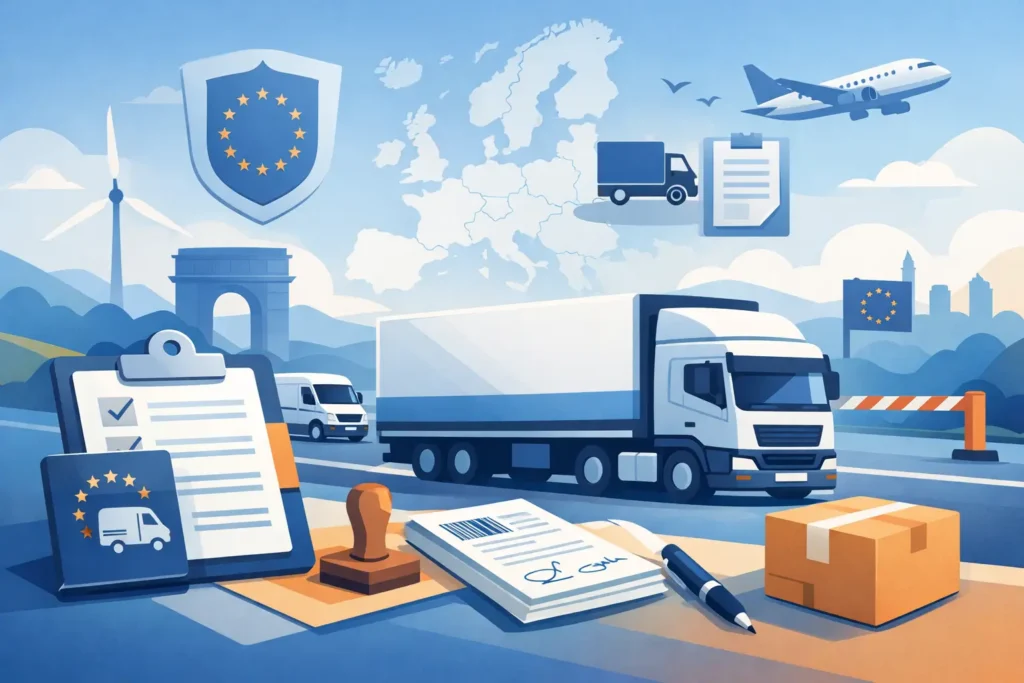
A truck can be loaded correctly, routed efficiently, and tracked in real time – and still get delayed at the border, at a roadside inspection, or at the consignee’s dock because one document is missing or inconsistent. In EU road freight, paperwork is not admin overhead. It is what keeps cargo moving on schedule.
For shippers, logistics coordinators, and transport buyers, the real question is not just what documents needed for EU road freight, but which ones are mandatory for your exact shipment, who is responsible for each document, and where mistakes usually happen. That distinction matters because a palletized intra-EU delivery does not require the same paperwork as a temperature-controlled shipment, bonded cargo movement, or goods entering the EU from a non-EU origin.
What documents needed for EU road freight?
For most EU road freight movements, the core document set includes the CMR consignment note, commercial invoice, packing list when needed, transport contract or shipping instructions, driver and vehicle documents, and any customs or permit paperwork required by the cargo and route.
That is the short answer. The operational answer is more specific: documents fall into four groups. First, cargo documents identify what is being transported. Second, transport documents prove the movement terms. Third, vehicle and driver documents confirm legal operation on the road. Fourth, regulatory documents cover customs, controlled goods, and route-specific compliance.
If one part is missing, the rest of the file may still not be enough to keep the shipment moving.
The core cargo and transport documents
CMR consignment note
The CMR is the standard transport document for international road freight under the Convention on the Contract for the International Carriage of Goods by Road. If your shipment is crossing borders by road within Europe, this is usually the first document transport teams check.
It records the shipper, carrier, consignee, loading place, delivery place, goods description, weight, package count, and handling instructions. It also matters in claims handling because it helps establish the condition and transfer of goods at pickup and delivery.
A common issue is inconsistency. If the CMR says 18 pallets and the packing list says 16, that discrepancy can trigger delays, questions at delivery, or disputes later. The CMR should match the commercial paperwork and the actual load.
Commercial invoice
The commercial invoice is essential even for many shipments moving inside the EU, because it identifies the seller, buyer, goods, values, product descriptions, and commercial terms. For customs movements, it is non-negotiable. For non-customs intra-EU deliveries, it still supports traceability, accounting, VAT treatment, and shipment verification.
Descriptions need to be clear enough to identify the goods. “Machine parts” is often too vague. “Steel brake components for passenger vehicles” is better. If customs or enforcement authorities need to understand what is in the vehicle, generic wording creates risk.
Packing list
Not every shipment needs a separate packing list, but many should have one. It becomes especially useful when goods are split across multiple pallets, cartons, or handling units, or when dimensions and gross and net weights need to be checked quickly.
For warehouse teams and receiving docks, the packing list is often the fastest way to validate the load without unpacking everything. For high-volume or mixed-SKU freight, it reduces errors and speeds up exception handling.
Transport order or shipping instructions
This is not always a formal legal document in the same way as the CMR, but operationally it is critical. It confirms what was booked: collection window, delivery slot, cargo type, temperature requirement, reference numbers, special handling, and any access restrictions.
When transport instructions are poorly documented, service failures follow. Drivers arrive without the right equipment, collection references are missing, or receivers reject the truck because no delivery slot was booked.
Driver and vehicle documents for EU road freight
A compliant load still needs a compliant vehicle and driver. Roadside checks focus on both.
The driver should carry a valid driver’s license appropriate to the vehicle class, identification documents, and where required, Driver CPC evidence. Depending on the operation, tachograph records and working time compliance may also be examined.
On the vehicle side, operators should be able to present vehicle registration documents and proof that the vehicle is authorized for commercial road transport. In many cases this includes the Community license or a certified copy carried in the vehicle for international hire-and-reward transport within the EU.
Proof of insurance is also standard. If the shipment involves trailers, swapped units, or subcontracted carriers, the file should be checked carefully. The assumption that the subcontractor has everything in order is where preventable compliance failures start.
Customs papers for shipments entering, leaving, or transiting
Intra-EU freight versus customs movements
This is where the phrase “EU road freight” can mislead people. If goods are moving between two EU member states and are already in free circulation, customs declarations may not apply. If the goods are entering the EU, leaving it, moving under transit, or include non-Union goods, customs paperwork becomes central.
That means the answer to what documents needed for EU road freight depends heavily on the customs status of the goods, not just the fact that a truck is driving in Europe.
Common customs documents
For customs-controlled road freight, teams may need export declarations, import declarations, transit documents such as T1 or T2, EORI details, and supporting commercial documents. In some cases, proof of origin or preference documents may also be needed where duty treatment depends on trade agreement eligibility.
If the goods are moving under a transit procedure, the reference data must align exactly with the shipment and vehicle details. Even small mismatches can result in border delays or issues closing the movement properly.
Customs responsibility also depends on Incoterms and commercial setup. A shipper may assume the carrier is handling customs, while the carrier assumes the customs broker has the file. That kind of ambiguity is expensive. Responsibility should be assigned clearly before pickup.
Special documents for regulated or sensitive cargo
Not all freight can move on standard paperwork alone.
Dangerous goods require ADR documentation, and the driver may need ADR certification depending on the load. Waste shipments can require waste transfer or transfrontier shipment documents. Food, animal products, and plant-based goods may need sanitary or phytosanitary paperwork. Pharmaceuticals, alcohol, tobacco, and dual-use goods can trigger license or control requirements.
Temperature-controlled freight often needs temperature instructions and, in some cases, evidence linked to equipment qualification or cargo condition. High-value cargo may call for tighter documentary controls at handover points.
This is where experienced planning matters. The more specialized the load, the less useful generic checklists become. A standard dry freight process will not reliably cover ADR, healthcare, or cross-border excise cargo.
The mistakes that delay EU road shipments most often
Most document failures are not caused by missing files. They are caused by mismatched information.
A wrong delivery address on the CMR. Invoice values that do not align with customs data. Package counts that differ across documents. Product descriptions too broad for inspection. Missing reference numbers for warehouse release. Trailer registration not updated in the transport file. These are the details that turn a scheduled movement into a reactive one.
Another frequent issue is timing. Documents exist, but they are not available to the driver, uploaded to the system, or shared with the consignee before arrival. In practical terms, late documentation can be almost as disruptive as no documentation at all.
Operationally strong transport teams treat documents as part of shipment control, not as paperwork to finish after loading.
How to manage EU road freight documents without losing control
The best approach is to build the document file in sequence. Start with the commercial data, validate the goods description and values, then match the transport instruction, then confirm whether customs or special cargo rules apply. Only after that should the dispatch file be released to the carrier and driver.
Digital visibility helps, but only if the process behind it is disciplined. Real-time tracking is valuable, yet tracking alone does not solve a missing CMR signature or an incomplete customs reference. The strongest operations combine live shipment visibility with documented checks at booking, pickup, border events, and proof of delivery.
For businesses shipping regularly, a document matrix works better than ad hoc email chains. By lane and cargo type, define which documents are mandatory, who creates them, who reviews them, and when they must be available. That reduces dependency on memory and lowers the risk when teams are busy.
For occasional shippers, the safer option is to work with a transport partner that can validate document readiness before dispatch. At Alconedo, that is part of the operational value: one controlled process, transparent communication, and documented transport execution that supports on-time delivery rather than hoping the file is complete when the truck reaches the checkpoint.
The fastest freight move is usually the one that feels uneventful – because every document was right, available, and aligned before the wheels started turning.
