
Pick a European Freight Forwarder That Fits SMBs
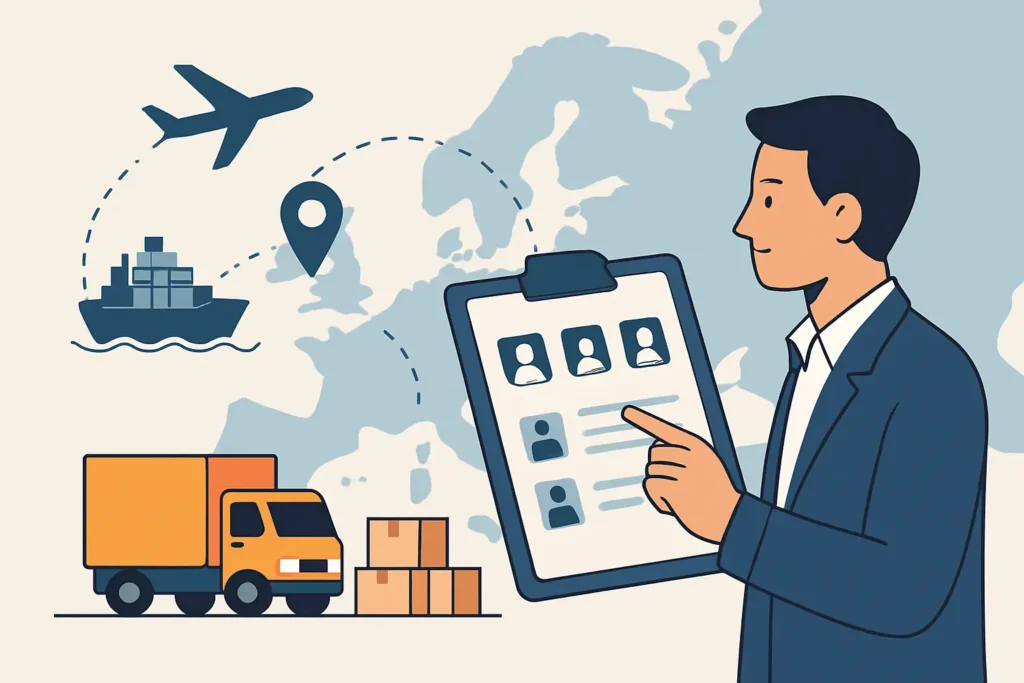
Your first Europe shipment usually fails in a boring place: a missing commodity code, a vague commercial invoice, a pickup window nobody confirmed, or a “delivered” scan with no proof of handoff. Small businesses do not lose money because cross-border transport is mysterious. They lose money because it is fragmented, and every handoff creates a new chance for silence.
A european freight forwarder for small business should reduce those handoffs, tighten the process, and keep you in control with documentation discipline and live visibility. Not with buzzwords, and not by pushing you into an enterprise contract you do not need.
What a freight forwarder actually does for an SMB
A forwarder is the coordinator of your shipment, not the truck, ship, or aircraft itself. For small businesses, that distinction matters because your risk is usually not “no capacity exists.” Your risk is that capacity exists but is booked incorrectly, cleared incorrectly, or communicated poorly.
A capable forwarder organizes transport across carriers, plans the route (and the backup route), sets pickup and delivery appointments, manages export and import requirements, and keeps the paperwork aligned with what customs and carriers will actually accept. The practical outcome is fewer exceptions, faster resolution when an exception does happen, and predictable landed cost.
The trade-off is that a forwarder adds a management layer. That layer is valuable only if it improves control and reduces the time you spend chasing updates.
The Europe reality: borders, rules, and “short distances” that are not short
From the US, Europe can look like a single compact market. Operationally, it is not.
Yes, the EU reduces friction inside the bloc, but you still have different port behaviors, different carrier performance on specific lanes, and real border procedures when a movement touches the UK, Switzerland, Norway, or other non-EU points. Even within the EU, shipments can stall due to documentation mismatches, safety requirements, or carrier appointment constraints at busy distribution centers.
This is why “it’s only a few hours away” is not a plan. A small business needs a forwarder that treats Europe like a set of operating zones with known constraints, not a single map.
How to choose the right service level (and avoid paying for the wrong one)
Most SMB shipping mistakes are service-level mismatches. You pick express when you needed certainty. Or you pick economy when you actually needed a delivery appointment and proof of receipt.
Air freight is best when time is the product, or when inventory carrying cost is higher than freight cost. It is also useful when you are stabilizing a new supply chain and want speed while you fix forecasting.
Ocean freight is best when volume is steady and you can plan. The hidden risk is not transit time, it is variability around port congestion, cutoffs, and drayage scheduling.
Road freight inside Europe is where many SMBs get surprised. Cross-border trucking can be fast, but only if pickup and delivery are planned tightly and the forwarder has reliable carrier coverage on that lane. The cheapest rate often comes with the loosest communication.
Rail and multimodal can be cost-effective on certain corridors, but you need a forwarder that can explain where the transfer points are and what visibility you will have between them.
The decision point is simple: are you optimizing for lowest cost, lowest risk of delay, or lowest management effort? You can usually get two, not all three.
The documentation standard you should demand
If your forwarder does not lead with documentation, they are not protecting your margin.
For small businesses shipping to or within Europe, the basics should be non-negotiable: accurate shipper and consignee details, precise product descriptions, correct HS codes, country of origin, Incoterms that match your commercial reality, and consistent values across the commercial invoice and any electronic filings.
The “it depends” scenario is when you sell through marketplaces, ship samples, or send returns. Samples, repairs, and temporary imports can have different treatment, and the wrong paperwork can trigger duties or delays that exceed the value of the goods.
Ask a forwarder what they do before pickup. If the answer is “we’ll fix it after booking,” you are likely to pay in storage, demurrage, or missed delivery appointments.
Customs support: what good looks like for an SMB
Customs is not just clearance. It is classification, valuation, origin logic, and knowing what documentation is expected for your product category.
A forwarder that supports small businesses should do three things consistently.
First, they should tell you what they need from you in plain language and review it early. Second, they should provide clear escalation paths when customs requests more information. Third, they should help you plan duty and tax exposure so you are not surprised at the moment of delivery.
If you ship DDP (Delivered Duty Paid), make sure your forwarder can actually execute it and explain how taxes will be paid and reconciled. If you ship DAP (Delivered at Place), make sure your customer understands their responsibilities so the cargo does not sit waiting for payment.
Visibility: real tracking, not “we will email you”
Small businesses do not have time for status ping-pong. You need operational visibility that answers basic questions immediately: where is it, what is the next event, and who is responsible for the next handoff.
At a minimum, insist on milestone-based tracking and proactive exception notifications. Better is real-time GPS tracking for road moves and a documented process for proof of pickup and proof of delivery.
The trade-off is that high-visibility moves can cost slightly more because the carrier network is tighter and the operational workload is higher. For an SMB, that premium is often cheaper than a single missed customer commitment.
The forwarder selection test: five questions that expose capability
You do not need a 30-page RFP to choose a forwarder. You need a short conversation that reveals whether they can run your lane reliably.
Ask how they handle your specific origin-destination pair, not “Europe” in general. Ask what documentation they validate before booking. Ask what their exception process looks like at 2 a.m. local time when a shipment is held. Ask how they confirm pickup and delivery appointments. Ask what you will see in tracking without having to request it.
A strong forwarder answers in procedures, not promises. You should hear words like cutoffs, handoff points, SLA, escalation, and proof of delivery.
Cost control for small businesses: where margins are actually lost
Freight cost is only one line item. SMBs usually lose margin through accessorials and preventable delays.
Common examples include incorrect dimensions leading to reweigh charges, missed pickups causing rebooking fees, storage at terminals due to paperwork delays, and delivery failures because nobody set an appointment or the consignee was not prepared to receive.
A forwarder earns their keep by preventing those charges through disciplined data capture and communication. If you only compare base rates, you are comparing the wrong thing.
When an integrated “movement” partner is the right move
Small businesses often manage freight, corporate travel, and local courier needs with separate vendors. That works until operations are under pressure: a part needs to reach a site today, a team needs to fly tomorrow, and a local delivery has to happen inside a two-hour window. Fragmentation is not just inefficient, it creates accountability gaps.
This is where an integrated mobility partner can reduce coordination overhead. If one group can coordinate European freight, book the urgent travel, and dispatch the last-mile courier with consistent visibility and a single support model, you spend less time managing vendors and more time running the business.
If you want that model, look for the same fundamentals across every service line: tracking, documented processes, vetted operators, and 24/7 support that treats exceptions as operational events, not email threads. One example of a company built around this connected approach is Alconedo, combining cross-border transport, travel booking, and app-based local movement under one operational umbrella.
Setting expectations with your customers (and saving your own team)
Even with a strong forwarder, you still need clean internal rules. Decide which products ship by which mode, define order cutoffs that match carrier reality, and standardize invoice and packing list templates.
Customer communication matters too. If you promise delivery dates without knowing what your Incoterms mean for responsibility and clearance timing, you will disappoint customers even when the forwarder performs.
A practical approach is to promise a delivery window that includes customs variability unless you are paying for a guaranteed service with tight control. Some lanes can support precision. Others should be managed with buffers.
The decision that makes everything easier
Pick the forwarder that makes the shipment boring.
Not the one with the lowest headline rate, and not the one that talks the most. The right european freight forwarder for small business is the one that can show you, in advance, how your shipment will be documented, moved, tracked, and recovered when something goes off plan. When that foundation is in place, Europe stops feeling like a risk and starts functioning like a repeatable lane you can build revenue on.
